
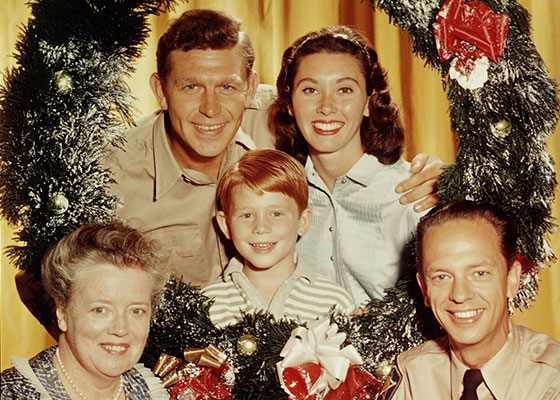
After the unsuccessful attempt to make Pat Harrington, Jr. the new lead in The Danny Thomas Show during the 1959-60 season, the series settled back into a comfortable groove. The only significant changes that season involved the shows surrounding it.
The previous season, Father Knows Best finished a series high 6th in the ratings as the 8:30 lead-in to The Danny Thomas Show. However, Robert Young decided to move on, and the series ended, replaced by the one-season flop, Bringing Up Buddy. The huge drop in its lead-in’s numbers affected The Danny Thomas Show, which dipped from 4th place to 12th, the first time a CBS Monday night at 9:00 sitcom fell out of the top 10. At 9:30, the Thomas spinoff, The Andy Griffith Show, finished in 4th place in its debut season.
Even though its lead-in the next season, Robert Young’s Window on Main Street, was a flop, The Danny Thomas Show returned to the top ten, ranking 8th for the 1961-62 season. Sid Melton’s Charley Halper character had been making appearances since 1959, and his role increased during the 1960-61 season. He became even more prominent in the fall of 1961 when his wife, Bunny, played by Emmy winner Pat Carroll, joined the cast. Having another couple involved in the series provided the writers with a new avenue to explore as the children in the cast grew up.
The 1962-63 season of The Danny Thomas Show was one of the most unusual in TV history. Danny and Kathy Williams took off for Europe early in the season, leading to several atypical episodes. The segments featuring Danny Thomas and Marjorie Lord, which were shot overseas, were filmed using a single camera. During their absence, the three-camera episodes shot at home with an audience were led by Melton and Carroll, as their characters looked after the Williams children. This was another failed attempt by Thomas to let other performers take the lead in the series. However, the viewers didn’t seem to mind as The Danny Thomas Show finished 7th in the ratings, helped by a robust new lead-in, The Lucy Show, which ended in 4th place. With The Andy Griffith Show (in 6th place) still following Thomas, CBS had a powerful top-ten trio on Mondays.
Returning to its regular format the following fall, The Danny Thomas Show continued to sail along at 9th place in the Nielsen ratings for the 1963-64 season. Despite this success, Thomas finally made good on his promise to quit the weekly grind. After 343 episodes, The Danny Thomas Show came to an end.
Thomas, along with Sheldon Leonard, was the head of a growing production empire that included returning shows for Andy Griffith, Dick Van Dyke, Joey Bishop, and Bill Dana, as well as two newcomers: Gomer Pyle, U.S.M.C., and The Tycoon. Only Griffith, Van Dyke, and Pyle would survive the 1964-65 season, with all three in the top ten. Thomas, however, would never star in another hit in five tries: The Danny Thomas Hour, Make Room for Granddaddy, The Practice, I’m a Big Girl Now, and One Big Family. Although he was eager to walk away from The Danny Thomas Show, he starred in several reunion specials, and Make Room for Granddaddy was essentially a revival of the old series.
With CBS needing a new 9:00 series for the first time in seven years, it’s logical that they turned to the sitcom star who originally occupied the slot, Lucille Ball. It would simply be a matter of rescheduling her successful show for a half hour later. It almost didn’t happen, though.
Having bought out ex-husband Desi Arnaz, Lucy was now running Desilu Productions and had threatened to give up her weekly series after just its first season. Desilu needed successful product, so Lucy relented, but once again hinted she would bow out at the end of the 1963-64 season. Co-star Vivian Vance had tired of commuting from the East Coast, and all of the I Love Lucy writers who had followed Ball to The Lucy Show had departed.
She also proposed expanding The Lucy Show to one hour or turning it into a series of specials. CBS preferred the show to return as a weekly half-hour. In February, The New York Times reported that Lucy would indeed end her weekly series, with the possibility of it returning as hour specials, just as had been done with I Love Lucy. CBS was so convinced that Lucy was serious that they considered moving Tuesday night hit Petticoat Junction to Monday to be paired with The Andy Griffith Show.
Just a month later, Lucy announced she would indeed continue with her weekly series, now airing at 9:00, with The Andy Griffith Show moving up to 8:30. Vance agreed to return if she could get a few weeks off, and a new writing staff (most coming over from their nightmarish stint on The Joey Bishop Show) was hired. Ball would frequently question whether to return for another season, but she loved to work, and CBS would cough up more money. Her production budget for the 1964-65 season was the largest for any sitcom. Additional episodes would also make The Lucy Show more attractive in syndication.
The new season started smoothly as the new Lucy writers found plenty of ways for her character, Lucy Carmichael, to get into humorous slapstick scrapes. Several episodes featured Lucy losing a valuable item, followed by a humorous frenzy to find it. The second half of the season was not as strong, as the series had deviated from its original premise of Lucy being an overwhelmed widow who found clever solutions to care for her children, house, and borders. Vance was missed when she took a few weeks off. Lucy’s close friend Ann Sothern filled in admirably, but only one of her episodes, “My Fair Lucy,” worked well. The Lucy Show remained in the top ten, ranking 8th.
The following season, The Lucy Show underwent a total revamp, as Vance and the children in the cast departed, and Lucille Carmichael and Mr. Mooney moved to California, and the series became heavily dependent on guest stars. Though the episodes were inferior to the show’s first three years, the audience still loved Lucy, and The Lucy Show soared into 3rd, 4th, and 2nd place over its final three seasons.
While The Lucy Show had been successful at 9:00, The Andy Griffith Show pulled even higher ratings, finishing in 4th place during the 1964-65 season. CBS decided to switch the two shows for the 1965-66 season, allowing The Lucy Show to capitalize on the younger audience available in the earlier time slot. Like The Lucy Show, the Griffith series was undergoing significant changes. Not only would it be seen in color for the first time, but it would also deal with the departures of popular co-star Don Knotts and producer Aaron Ruben.
Griffith had previously expressed interest in ending the show after five seasons, but agreed to forge ahead. Although there were some entertaining episodes during the 1964-65 season, the popular series was starting to show wear. Most of its country charm was gone, the Taylor family had largely ceased to be funny, plots had grown repetitive, and even Knotts’ Barney Fife was sometimes more annoying than amusing. Those problems became more apparent in the 1965-66 season, which was dominated by humorless segments. Barney’s replacement, Warren, played by Jack Burns, was so disliked that he lasted only 11 episodes. Oddball characters like Otis, Ernest T. Bass, and the Darlings barely showed up in the color seasons.
In those days of pre-internet chatter, the creative deterioration of the series didn’t seem to matter. The Andy Griffith Show finished in a strong 6th place in the Nielsen ratings. A year later, it inexplicably jumped to 3rd, although the episodes were slightly better. However, with Howard McNear (Floyd the barber) no longer able to physically continue on the show after the 7th season, the 8th season suffered significantly in terms of humor. Yet, The Andy Griffith Show and The Lucy Show battled for the top spot throughout the entire season. Griffith pulled ahead late in the season as The Lucy Show faced formidable competition beginning at mid-season, when NBC launched Rowan & Martin’s Laugh-In opposite Ball.
Even though his series reached the top spot, Griffith was ready to end the show and transition into making movies. So a plan was devised to keep Mayberry alive in a new series. Former F Troop actor Ken Berry was introduced late in the season as farmer Sam Jones, the new head of the town council. The final episode of The Andy Griffith Show was a dreadful backdoor pilot for the subsequent series, Mayberry R.F.D.. Jones dealt with an obnoxious Italian family, the Vincentes, who moved to his farm. Fortunately, that was the last we heard of them, as they were not included in the spinoff.
Mayberry R.F.D. launched as a weekly series in the fall of 1968 in The Andy Griffith Show’s old timeslot. The debut episode concerned Andy Taylor’s wedding to Helen Crump and was the overwhelming number one show in that week’s ratings. The new series emulated the Griffith show, as Sam Jones became the de facto town leader; his son, Mike, took the place of Opie; his girlfriend, Millie, replaced Helen; and even Aunt Bee came to live with the Jones family. Andy’s buddies Howard, Goober, and Floyd were now Sam’s best friends. Like the color years of The Andy Griffith Show, Mayberry R.F.D. was seldom very funny, but somehow very popular.
The Lucy Show transitioned that season to a new Lucille Ball series, Here’s Lucy, which didn’t provide as strong of a lead-in. However, it finished a still potent 9th place against the now overwhelming number one series, Rowan & Martin’s Laugh-In. Mayberry R.F.D. usually finished 2nd most weeks early in the season, and finished 4th for the year, trailing only Laugh-In, Gomer Pyle U.S.M.C., and Bonanza. Mayberry R.F.D. repeated as the 4th highest ranked series in the 1969-70 season, with Here’s Lucy increasing to 6th place as its lead-in. By season’s end, Lucy started beating Laugh-In, although that series would still stand as the top-ranked show for the season.
At the end of the 1960s, since 1951, the Monday nights at 9:00 timeslot had been occupied by Lucy or a show from the Danny Thomas family tree. Although that tradition would continue for a few more years, a jarring transition was on the horizon.
Leave a Reply