
In 1951, I Love Lucy became the first television sitcom to achieve massive success. Its momentum was so great that CBS continued to program nothing but sitcoms on Monday night in the 9:00 p.m. (ET) time slot during the regular season until 2014.
There’s not much new to say about I Love Lucy. The 2021 theatrical film, Being the Ricardos, stooped to making things up and pretending that the things it got right all happened in one week. However, the one thing that is underreported about this huge hit is the role Arthur Godfrey’s Talent Scouts played in its initial success.
Rewind one season to 1950, when Godfrey’s series ranked 8th in the Nielsen ratings, airing on Monday nights at 8:30. Another talent show, The Horace Heidt Show, followed. When Heidt’s series didn’t catch on, CBS wisely gave the plum Monday at 9:00 slot to Lucille Ball’s new series for the 1951-52 season.
Ball was a proven commodity — a success in movies and radio. CBS originally wanted to adapt Ball’s radio comedy My Favorite Husband for TV. However, Ball wished to do a new series with her husband, Desi Arnaz. A vaudeville tour and a pilot film convinced skeptical CBS executives that the duo were comedically compatible.
At the peak of her comedic abilities and surrounded by top talent in front of and behind the cameras, Ball’s new TV sitcom caught on immediately, airing classic episodes like “The Ballet,” “Pioneer Women,” “The Freezer,” and “Lucy Does a TV Commercial” (episode 30, BTW) in its debut season. While I Love Lucy garnered tremendous ratings, it didn’t lead the Nielsens in 1951-52. That honor went to Arthur Godfrey’s Talent Scouts, with I Love Lucy finishing in third. Had CBS known I Love Lucy would become such a big hit, they might have programmed another comedy behind it, rather than the panel quiz show It’s News To Me, which did not retain an acceptable percentage of Lucy viewers.
While Lucy did drop a few viewers from Godfrey’s program in her first year, the next season, I Love Lucy passed Godfrey and soared to the number one spot with an astounding 67.3 rating. Yes rating, not share! It didn’t take long for the Godfrey lead-in to become just gravy as the Ricardos had no trouble attracting their own viewers. The second season opened with the classic candy assembly line routine in the episode “Job Switching.” However, the real draw that season was Lucille Ball’s and Lucy Ricardo’s pregnancy. Originally thought to be a threat to the show’s second season, this happenstance instead brought new interest to the show when it was integrated into the storyline. The birth of Little Ricky in early 1953 led to record viewership.
I Love Lucy remained the number one program in its third season, as motherhood didn’t tone down Lucy Ricardo’s antics. The show faced another threat early in the season, as Lucy was briefly caught up in the Red Scare. However, the case was quickly resolved, and the show’s popularity continued unabated.
For the remainder of the show’s run, new settings were introduced to keep the show fresh. In season four, the cast went to Hollywood when Ricky Ricardo landed a movie contract. The initial Hollywood episode, “L.A. at Last,” featured Lucy’s hilarious run-in with William Holden, one of an increasing number of guest stars on the series.
I Love Lucy continued to be television’s top-rated program during the fourth season, and the Hollywood storyline continued into the fifth year. There was little chance of the series getting stale, as the characters soon embarked on another adventure, this time to Europe. What an excellent excuse for Lucy to stomp grapes in “Lucy’s Italian Movie.” Quiz show mania was at its height, and I Love Lucy was edged out by The $64,000 Question in the final Nielsen ratings for the 1955-56 season.
Lucy returned to the top of the ratings the following season, despite facing opposition from the pre-quiz show scandal series, Twenty-One. The Ricardos’ return to New York City and the departure of producer/head writer Jess Oppenheimer led to a mini-slump creatively at the beginning of the season. However, the show shook things up with a mid-season move to the country, which was the setting for several funny episodes, including “Lucy Does the Tango,” the source of the longest laugh in series history, as Lucy gets dozens of eggs smashed in her blouse.
It’s difficult to say how long I Love Lucy could have continued at the top of the ratings, but Ball and Arnaz decided to give up the weekly series as their Desilu Productions empire continued to grow. It was initially announced that the Arnazes would do monthly one-hour I Love Lucy specials the following season, possibly in color. Retitled The Lucille Ball-Desi Arnaz Show, only 13 of these specials aired over the next three years, all in black and white.
So the nine o’clock time slot would need a new occupant in the fall of 1957. TV Guide speculated that CBS would not have another sitcom on Monday at 9 p.m. and instead would fill the slot with The Big Record, a new hour-long musical variety show. Later, it announced that a new comedy, Dick and the Duchess, would inherit the slot, likely followed by The Danny Thomas Show, a low-rated sitcom that had just completed its fourth season, coming over from ABC. Neither The Big Record nor Dick and the Duchess secured Lucy’s old slot, and both only lasted one season in their eventual homes.
One would have expected CBS to program one of its incumbent sitcoms in the slot. Desi Arnaz campaigned to have Desilu’s December Bride take over the slot. A perennial top 10 hit in the 9:30 slot behind I Love Lucy, ithad just finished fifth in the 1956-57 season. However, in June of 1957, TV Guide reversed their previous stories and announced that The Danny Thomas Show would occupy the Monday at 9 p.m. slot on CBS that fall.
Sponsors had a great deal of sway over programming in the 1950s and General Foods, which controlled the Monday at 9:00 time slot on CBS, negotiated for Thomas’ series to air there. Originally called Make Room for Daddy, the series was acclaimed, winning Emmys for Best New Program in 1954 and Best Comedy Series and Best Actor in 1955. However, it was at a significant ratings disadvantage airing on ABC, which had far fewer affiliate stations than CBS and NBC. The network’s only hit during the mid-1950s was Disneyland.
Make Room for Daddy was based on Thomas’ real life as an entertainer, often on the road, whose family had to adapt when he was home. The series underwent a significant change in season four when Thomas’ Danny Williams became a widower as Jean Hagen, who had played his wife, left the series. Late in the fourth season, he became engaged to a widow played by Marjorie Lord, setting up a fresh concept for the series’ move to CBS.
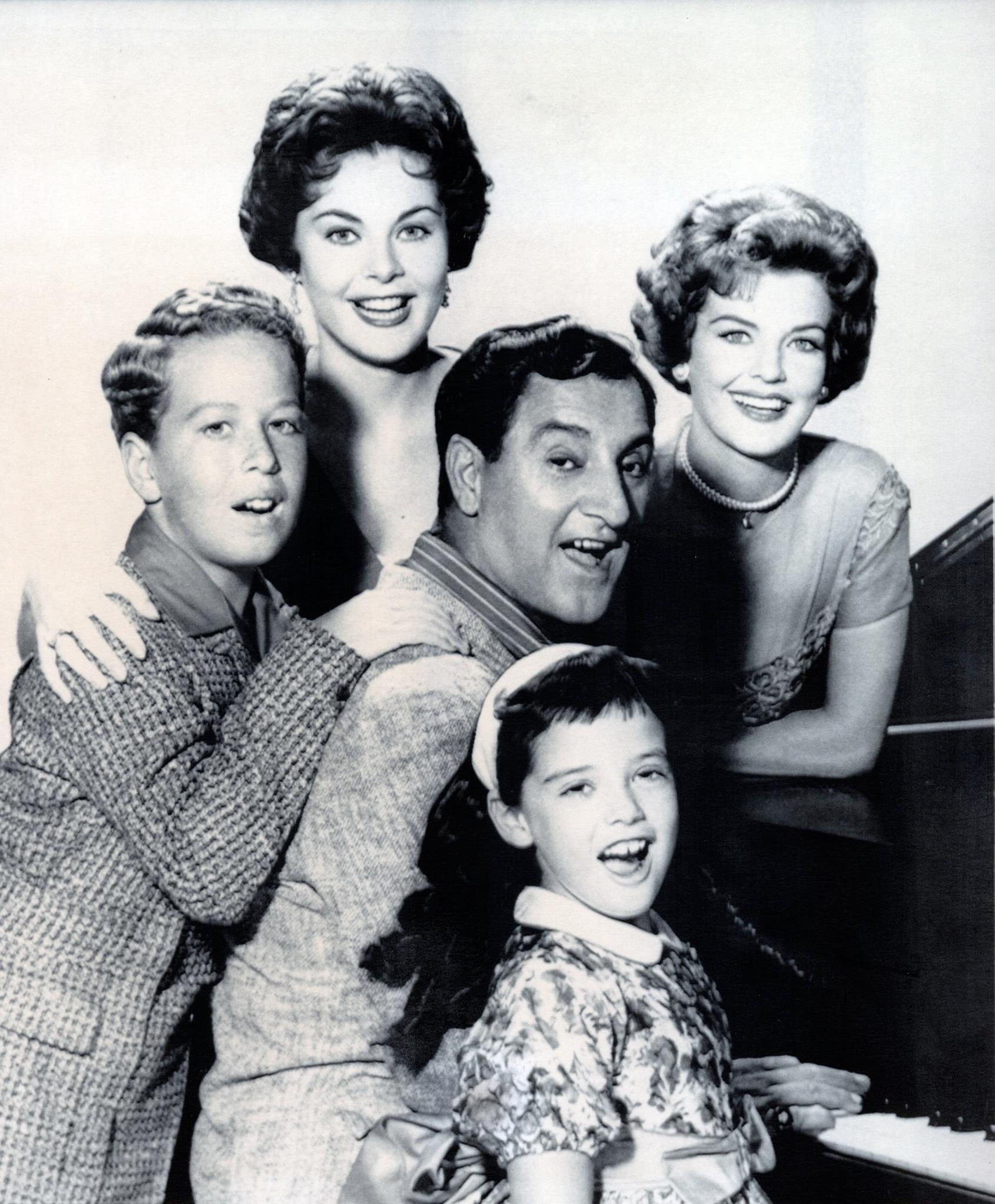
With Majorie Lord and Angela Cartwright now regulars and Danny Williams’ children, played by Sherry Jackson and the hilarious Rusty Hamer, remaining regulars, the series thrived on plots about the new blended family, while also continuing to focus on Danny Williams’ show business career. That career also gave the series an increasing reason to feature big-name guest stars.
Although CBS was initially unhappy with being stuck with The Danny Thomas Show, it proved to be another sizable hit for the network. In 1957-58, Westerns dominated much of the program schedule, and Gunsmoke became the new top-rated program. Right behind it, in second place, was The Danny Thomas Show. Westerns took six of the top seven spots the following season, joined by The Danny Thomas Show in fifth place.
Sherry Jackson, who played Terry Williams, left the show early in the sixth season, and Annette Funicello briefly joined the show as a foreign exchange student. The following season, the show continued its popularity, finishing fourth in the Nielsen Ratings. The Terry character returned for one season, now played by Penney Parker.
Two developments in the 1959-60 season would have repercussions for the Monday night at 9:00 time slot in future seasons. The very funny backdoor pilot “Danny Meets Andy Griffith” would help Thomas and producer/director Sheldon Leonard build a production powerhouse when the subsequent series, The Andy Griffith Show, premiered behind the Thomas show the following fall. Thomas was beginning to tire of the weekly grind of starring in a series. He seriously considered cutting back his and Marjorie Lord’s roles and turning the series over to Pat Harrington, Jr., who played Terry’s new boyfriend and eventual husband in 11 episodes during the 1959-60 season. However, no one was pleased with this plan, and Harrington and Parker were dropped from the show at the end of the season. This would not be the only time Thomas threatened to abandon the lead role.
Leave a Reply