
What constitutes a spinoff anyway? The obvious answer is that a popular continuing character or characters on a successful series get their own show. Think Gomer Pyle U.S.M.C., The Jeffersons, Rhoda, Benson, Frasier, etc.
A second category involves guest stars making such a splash that series are developed for them. Maude, Laverne & Shirley, and Mork & Mindy began that way.
Here’s where it gets tricky. Some shows air because of their association with an existing series, but do not spin off a current character from that show. So, are they spinoffs or not? Depends on your definition. Are you a stickler for authenticity, or does any tenuous connection count in making these shows spinoffs?
704 Hauser
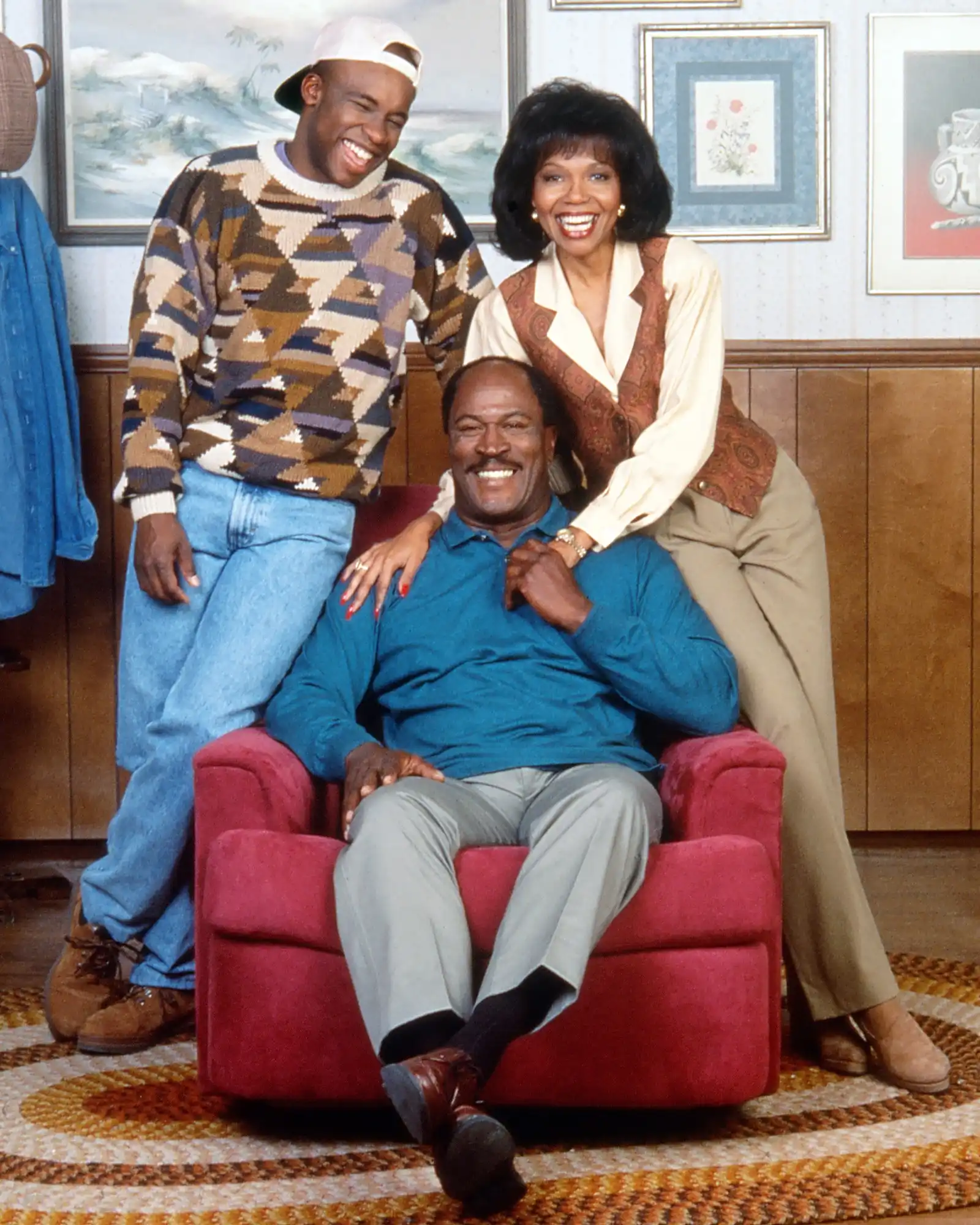
Can a set be spun off? Paying to store the All in the Family set, Norman Lear reused it in the 1994 sitcom, 704 Hauser, about an African-American family living in the old Bunker home. Like All in the Family, 704 Hauser featured a generational divide, this time with a liberal father and conservative son. John Amos starred, even though Lear fired him from Good Times in 1976 for being combative.
The series’ other flimsy connection to All in the Family was a brief pilot appearance by a grown-up Joey Stivic, Archie’s grandson. Amos was great, but the father/son arguments lacked the spark and importance of the original. The show lasted just five weeks.
Green Acres
If you can spin off a set, why not a town? In 1965, Paul Henning had his hands full writing and producing The Beverly Hillbillies and producing Petticoat Junction. When CBS requested another show from Henning, he turned to Petticoat Junction Executive Producer Jay Sommers. Sommers updated his old radio series, Granby’s Green Acres, about city slickers moving to a dilapidated farm. Henning was the executive producer, but was mostly hands-off. He did suggest the series be set in the same Hooterville location as Petticoat Junction.
While Green Acres’ Oliver and Lisa Douglas had not previously appeared on Petticoat Junction, several other previously seen Hooterville denizens starred on Green Acres. Storekeeper Sam Drucker was a regular on both shows. Minor Petticoat players Fred and Doris Ziffel and Newt Kiley showed up more frequently on Green Acres. During Green Acres’ first season, Petticoat Junction stars Bea Benaderet, Edgar Buchanan, Rufe Davis, and Smiley Burnett made appearances on Green Acres, while Lisa and Oliver Douglas popped up on some Petticoat Junction segments. Green Acres quickly surpassed Petticoat Junction in the ratings, so crossovers were less frequent in subsequent seasons. The two shows shared little in common tone-wise, as Green Acres thrived on surreal humor, while Petticoat Junction was a straightforward family show. Green Acres lasted until 1971, one year after CBS canceled Petticoat Junction, although Petticoat ran seven seasons to Green Acres’ six.
The Betty White Show
Phyllis, a real spinoff from The Mary Tyler Moore Show, started strongly in 1975, finishing sixth in the season’s ratings. However, producers struggled to make Cloris Leachman’s caustic character work as a lead. Ratings fell after a retooling, and CBS surprisingly dropped the series after two seasons. Hoping to avoid similar issues, producers Ed. Weinberger and Stan Daniels didn’t directly spin off Betty White’s Sue Ann Nivens character from The Mary Tyler Moore Show in 1977. White played a slightly softer new character, Joyce Whitman, an actress on a police show. MTM’s Georgia Engel co-starred. Though playing new characters, it’s clear viewers were supposed to equate them to their MTM roles.
The Betty White Show premiered in the top 10. After that, the show’s ratings were volatile. Sometimes solid, sometimes surprisingly bad. CBS shocked MTM Enterprises by canceling the show at mid-season. White blamed the fact that Weinberger and Daniels departed after the pilot to develop Taxi. Weinberger blamed himself for not continuing the Sue Ann Nivens character.
Hanging In
Once a top-five series, Maude was sinking in the ratings in 1978, and most of the supporting cast was departing. In the season finale, Maude was elected to Congress and moved to Washington, D.C. Expecting to come in like a lion, she had to act like a lamb to achieve her ideals. With a new supporting cast, the episode served as a kind of pilot for a seventh season. However, Bea Arthur declined to start over, and the episode became the series finale.
Never one to waste a good idea, Norman Lear picked at the bones of Maude’s corpse to develop a new series about a freshman congressperson clashing with an experienced staff. Though John Amos had been dropped from Good Times, he was cast as the lead in Onward and Upward. However, he departed before the show aired. Renamed Mr. Dugan, the show was scheduled to air behind All in the Family in March 1979. Lear showed the pilot, now starring Blazing Saddles’ Cleavon Little, to African-American congresspeople. They objected to the show and Little’s performance. Lear decided not to deliver the series to CBS. The producers renamed the show Hanging In, changed the setting to academia, cast Maude’s Bill Macy in the lead, and kept the same supporting cast from all versions. It aired quietly in the summer of 1979 and lasted exactly four weeks.
Trapper John, M.D.
Talk about stretching the definition of spinoff to its limits. Trapper John had not been on M*A*S*H for four years when this show debuted in 1979. Trapper John, M.D. placed him in a different era in a new format (drama). Pernell Roberts subbed for Wayne Rogers even though they looked (especially in the hair department) and sounded nothing alike. Roberts was just a few years older than Rogers even though he was playing the character 27 years after Trapper’s M*A*S*H departure. Roberts’ Trapper was much more sedate than Rogers’. The familiar name was just a gimmick to draw viewers to a standard medical drama from the Medical Center creative team.
The gimmick worked. Airing at the end of CBS’ powerful Sunday night lineup, Trapper John, M.D. ran seven years, hitting the top 20 four times. The show’s origins led to a lawsuit by Ingo Preminger, who produced the M*A*S*H movie. He won a share of the series’ profits as he had rights to royalties for use of material from the movie. While 20th Century Fox lost that lawsuit, it fended off charges from the producers of the M*A*S*H TV show. The studio successfully claimed Trapper was based on the movie and book character, not the TV version.
Blansky’s Beauties
Talk about a weird history and afterlife. Conceived for Roz Kelly’s Pinky Tuscadero, who created a sensation on Happy Days, the Pinky Tuscadero pilot went unsold. Nancy Walker was under contract to ABC, and when The Nancy Walker Show was canceled, she was cast in a new version of the Pinky pilot, now centering on a choreographer and den mother to Las Vegas showgirls. Blansky’s Beauties premiered in February 1977. Kelly appeared as Pinky in the first episode, but was reportedly difficult to work with and dropped from the show.
Blansky’s Beauties had other connections to Happy Days. Walker’s Nancy Blansky appeared the week before the Blansky’s debut as Howard Cunningham’s cousin on a Happy Days clip show. The series also revived Pat Morita’s Happy Days character, Arnold, after the cancellation of Morita’s sitcom Mr. T. and Tina. The new series was set about 20 years after Happy Days, but characters who appeared on both series did not age. After a strong start, the patched-together show faded fast and was canceled after 13 weeks. Unbelievably, Executive Producer Garry Marshall sold a revised version, called Legs, to NBC in 1978. Before airing, the series became more family-friendly under the new name Who’s Watching the Kids? Three supporting actors from Blansky’s Beauties were in the cast. This rendition predictably went down the tubes after nine showings.
E/R
This has one of the weakest connections of any of the sort of spinoffs. Sherman Hemsley appeared as George Jefferson in the pilot for the 1984 sitcom E/R. The reason? One of the show’s nurses was said to be his niece, who had never been mentioned during 10 years of The Jeffersons. The incredible cast included Elliot Gould in his first series role, Mary McDonnell, Conchata Ferrell, Lynne Moody, George Clooney, and Jason Alexander, with a few appearances by Pamela Adlon and Karen Black. Clooney had better luck with his next ER series.
Despite the cast, the show was doomed by its time slots. Airing on Tuesday opposite the top-ten series The A-Team and the Three’s Company continuation Three’s a Crowd, E/R was also handicapped by its failing lead-in, AfterMASH. At mid-season, E/R moved to Wednesday. Against still more hits (Highway to Heaven and The Fall Guy) and led-in by another flop (Charles in Charge), E/R’s ratings did not improve, and it was canceled at season’s end.
Together We Stand
With The Brady Bunch on its last legs in 1974, creator/executive producer Sherwood Schwartz used the aging series to introduce the proposed sitcom Kelly’s Kids. Aired as a backdoor pilot, the concept concerned a couple who adopt children of different ethnicities. ABC passed on the pilot and canceled The Brady Bunch, as light family comedies were no longer in vogue.
Fast forward to 1986. Schwartz revived the idea as family comedies were topping the ratings and CBS hoped to get in on the trend. Now titled Together We Stand, this version starred Elliott Gould, Dee Wallace, and Ke Huy Quan. Charles in Charge producer Michael Jacobs was the showrunner. The show was a quick failure, pulled after six episodes. Gould was dropped from the cast, and the show reappeared as Nothing is Easy, which lasted only seven episodes. Hardly worth the 12-year wait.
Empty Nest
Empty Nest originated as a backdoor pilot episode of The Golden Girls, which is widely unpopular with fans. The original 1987 pilot, called “Empty Nests,” starred Paul Dooley and Rita Moreno. Despite a script by Susan Harris and direction from Jay Sandrich, who made magic on The Golden Girls pilot, this prospective series was rather lifeless, even with appearances by the girls.
Harris then wrote a new pilot script that reimagined Dooley’s doctor character as a widower with a new name (Harry Weston). With Richard Mulligan now in the lead, everything clicked. Retaining the one thing that worked from the original pilot, David Leisure as an obnoxious neighbor (now with a different name), Harris added a fine cast of regulars, including Krisy McNichol, Dinah Manoff, and scene stealer Park Overall. After rejecting the original pilot, NBC eagerly bought the new version and scheduled it behind The Golden Girls. The pilot used the same set as the unsold one, and was still set next door to The Golden Girls. Although these exact characters had never previously guest-starred on The Golden Girls, the two shows shared crossovers. Empty Nest was a huge hit, running seven seasons. Empty Nest even had its own sort of spinoff, as another Susan Harris sitcom, Nurses, was set in the same building as Harry Weston’s practice, and the characters made crossovers.
Tabitha
Four years after Bewitched, ABC tried to launch a sitcom about Samantha’s daughter. Even though she would only be 10 by then, I guess ABC figured she was a witch, so why not? The pilot featured a grown-up Tabitha (Tabatha in this version) and her even younger, but also somehow adult, mischievous brother, Adam. Mimicking Bewitched, she revealed her identity as a witch to her boyfriend. Despite the presence of Bewitched producer/director William Asher and writer Ed Jurist, the pilot did not sell. ABC made a new Tabitha pilot, replacing lead actress Liberty Williams with Lisa Hartman. A new actor played Adam, as well. Unlike the original pilot, Adam was a mortal, creating tension with Tabitha and making him more of a Darrin than an Endora. Karen Morrow played never-before-mentioned Aunt Minerva, who was more like the wacky relatives in Bewitched.
This pilot aired in May 1977, but it did not make the fall schedule. However, the network ordered more episodes and randomly dropped one in September. The show finally got a regular timeslot in November, but after a strong start, it quickly fell in the ratings, leading to its January 1978 cancellation. Without the originality, stakes, and especially the cast of the mother show, failure seemed inevitable. A few minor Bewitched characters guest-starred (Dr. Bombay, the Kravitzs). Still, the only regular ties to the original were grown-up Tabitha and Adam, who were very different from their Bewitched versions.
Are These Spinoffs of Classic Sitcoms or Not?
What constitutes a spinoff anyway? The obvious answer is that a popular continuing character or characters on a successful series get their own show. Think Gomer Pyle U.S.M.C., The Jeffersons, Rhoda, Benson, Frasier, etc.
A second category involves guest stars making such a splash that series are developed for them. Maude, Laverne & Shirley, and Mork & Mindy began that way.
Here’s where it gets tricky. Some shows air because of their association with an existing series, but do not spin off a current character from that show. So, are they spinoffs or not? Depends on your definition. Are you a stickler for authenticity, or does any tenuous connection count in making these shows spinoffs?
704 Hauser
Can a set be spun off? Paying to store the All in the Family set, Norman Lear reused it in the 1994 sitcom, 704 Hauser, about an African-American family living in the old Bunker home. Like All in the Family, 704 Hauser featured a generational divide, this time with a liberal father and conservative son. John Amos starred, even though Lear fired him from Good Times in 1976 for being combative.
The series’ other flimsy connection to All in the Family was a brief pilot appearance by a grown-up Joey Stivic, Archie’s grandson. Amos was great, but the father/son arguments lacked the spark and importance of the original. The show lasted just five weeks.
Green Acres
If you can spin off a set, why not a town? In 1965, Paul Henning had his hands full writing and producing The Beverly Hillbillies and producing Petticoat Junction. When CBS requested another show from Henning, he turned to Petticoat Junction Executive Producer Jay Sommers. Sommers updated his old radio series, Granby’s Green Acres, about city slickers moving to a dilapidated farm. Henning was the executive producer, but was mostly hands-off. He did suggest the series be set in the same Hooterville location as Petticoat Junction.
While Green Acres’ Oliver and Lisa Douglas had not previously appeared on Petticoat Junction, several other previously seen Hooterville denizens starred on Green Acres. Storekeeper Sam Drucker was a regular on both shows. Minor Petticoat players Fred and Doris Ziffel and Newt Kiley showed up more frequently on Green Acres. During Green Acres’ first season, Petticoat Junction stars Bea Benaderet, Edgar Buchanan, Rufe Davis, and Smiley Burnett made appearances on Green Acres, while Lisa and Oliver Douglas popped up on some Petticoat Junction segments. Green Acres quickly surpassed Petticoat Junction in the ratings, so crossovers were less frequent in subsequent seasons. The two shows shared little in common tone-wise, as Green Acres thrived on surreal humor, while Petticoat Junction was a straightforward family show. Green Acres lasted until 1971, one year after CBS canceled Petticoat Junction, although Petticoat ran seven seasons to Green Acres’ six.
The Betty White Show
Phyllis, a real spinoff from The Mary Tyler Moore Show, started strongly in 1975, finishing sixth in the season’s ratings. However, producers struggled to make Cloris Leachman’s caustic character work as a lead. Ratings fell after a retooling, and CBS surprisingly dropped the series after two seasons. Hoping to avoid similar issues, producers Ed. Weinberger and Stan Daniels didn’t directly spin off Betty White’s Sue Ann Nivens character from The Mary Tyler Moore Show in 1977. White played a slightly softer new character, Joyce Whitman, an actress on a police show. MTM’s Georgia Engel co-starred. Though playing new characters, it’s clear viewers were supposed to equate them to their MTM roles.
The Betty White Show premiered in the top 10. After that, the show’s ratings were volatile. Sometimes solid, sometimes surprisingly bad. CBS shocked MTM Enterprises by canceling the show at mid-season. White blamed the fact that Weinberger and Daniels departed after the pilot to develop Taxi. Weinberger blamed himself for not continuing the Sue Ann Nivens character.
Hanging In
Once a top-five series, Maude was sinking in the ratings in 1978, and most of the supporting cast was departing. In the season finale, Maude was elected to Congress and moved to Washington, D.C. Expecting to come in like a lion, she had to act like a lamb to achieve her ideals. With a new supporting cast, the episode served as a kind of pilot for a seventh season. However, Bea Arthur declined to start over, and the episode became the series finale.
Never one to waste a good idea, Norman Lear picked at the bones of Maude’s corpse to develop a new series about a freshman congressperson clashing with an experienced staff. Though John Amos had been dropped from Good Times, he was cast as the lead in Onward and Upward. However, he departed before the show aired. Renamed Mr. Dugan, the show was scheduled to air behind All in the Family in March 1979. Lear showed the pilot, now starring Blazing Saddles’ Cleavon Little, to African-American congresspeople. They objected to the show and Little’s performance. Lear decided not to deliver the series to CBS. The producers renamed the show Hanging In, changed the setting to academia, cast Maude’s Bill Macy in the lead, and kept the same supporting cast from all versions. It aired quietly in the summer of 1979 and lasted exactly four weeks.
Trapper John, M.D.
Talk about stretching the definition of spinoff to its limits. Trapper John had not been on M*A*S*H for four years when this show debuted in 1979. Trapper John, M.D. placed him in a different era in a new format (drama). Pernell Roberts subbed for Wayne Rogers even though they looked (especially in the hair department) and sounded nothing alike. Roberts was just a few years older than Rogers even though he was playing the character 27 years after Trapper’s M*A*S*H departure. Roberts’ Trapper was much more sedate than Rogers’. The familiar name was just a gimmick to draw viewers to a standard medical drama from the Medical Center creative team.
The gimmick worked. Airing at the end of CBS’ powerful Sunday night lineup, Trapper John, M.D. ran seven years, hitting the top 20 four times. The show’s origins led to a lawsuit by Ingo Preminger, who produced the M*A*S*H movie. He won a share of the series’ profits as he had rights to royalties for use of material from the movie. While 20th Century Fox lost that lawsuit, it fended off charges from the producers of the M*A*S*H TV show. The studio successfully claimed Trapper was based on the movie and book character, not the TV version.
Blansky’s Beauties
Talk about a weird history and afterlife. Conceived for Roz Kelly’s Pinky Tuscadero, who created a sensation on Happy Days, the Pinky Tuscadero pilot went unsold. Nancy Walker was under contract to ABC, and when The Nancy Walker Show was canceled, she was cast in a new version of the Pinky pilot, now centering on a choreographer and den mother to Las Vegas showgirls. Blansky’s Beauties premiered in February 1977. Kelly appeared as Pinky in the first episode, but was reportedly difficult to work with and dropped from the show.
Blansky’s Beauties had other connections to Happy Days. Walker’s Nancy Blansky appeared the week before the Blansky’s debut as Howard Cunningham’s cousin on a Happy Days clip show. The series also revived Pat Morita’s Happy Days character, Arnold, after the cancellation of Morita’s sitcom Mr. T. and Tina. The new series was set about 20 years after Happy Days, but characters who appeared on both series did not age. After a strong start, the patched-together show faded fast and was canceled after 13 weeks. Unbelievably, Executive Producer Garry Marshall sold a revised version, called Legs, to NBC in 1978. Before airing, the series became more family-friendly under the new name Who’s Watching the Kids? Three supporting actors from Blansky’s Beauties were in the cast. This rendition predictably went down the tubes after nine showings.
E/R
This has one of the weakest connections of any of the sort of spinoffs. Sherman Hemsley appeared as George Jefferson in the pilot for the 1984 sitcom E/R. The reason? One of the show’s nurses was said to be his niece, who had never been mentioned during 10 years of The Jeffersons. The incredible cast included Elliot Gould in his first series role, Mary McDonnell, Conchata Ferrell, Lynne Moody, George Clooney, and Jason Alexander, with a few appearances by Pamela Adlon and Karen Black. Clooney had better luck with his next ER series.
Despite the cast, the show was doomed by its time slots. Airing on Tuesday opposite the top-ten series The A-Team and the Three’s Company continuation Three’s a Crowd, E/R was also handicapped by its failing lead-in, AfterMASH. At mid-season, E/R moved to Wednesday. Against still more hits (Highway to Heaven and The Fall Guy) and led-in by another flop (Charles in Charge), E/R’s ratings did not improve, and it was canceled at season’s end.
Together We Stand
With The Brady Bunch on its last legs in 1974, creator/executive producer Sherwood Schwartz used the aging series to introduce the proposed sitcom Kelly’s Kids. Aired as a backdoor pilot, the concept concerned a couple who adopt children of different ethnicities. ABC passed on the pilot and canceled The Brady Bunch, as light family comedies were no longer in vogue.
Fast forward to 1986. Schwartz revived the idea as family comedies were topping the ratings and CBS hoped to get in on the trend. Now titled Together We Stand, this version starred Elliott Gould, Dee Wallace, and Ke Huy Quan. Charles in Charge producer Michael Jacobs was the showrunner. The show was a quick failure, pulled after six episodes. Gould was dropped from the cast, and the show reappeared as Nothing is Easy, which lasted only seven episodes. Hardly worth the 12-year wait.
Empty Nest
Empty Nest originated as a backdoor pilot episode of The Golden Girls, which is widely unpopular with fans. The original 1987 pilot, called “Empty Nests,” starred Paul Dooley and Rita Moreno. Despite a script by Susan Harris and direction from Jay Sandrich, who made magic on The Golden Girls pilot, this prospective series was rather lifeless, even with appearances by the girls.
Harris then wrote a new pilot script that reimagined Dooley’s doctor character as a widower with a new name (Harry Weston). With Richard Mulligan now in the lead, everything clicked. Retaining the one thing that worked from the original pilot, David Leisure as an obnoxious neighbor (now with a different name), Harris added a fine cast of regulars, including Krisy McNichol, Dinah Manoff, and scene stealer Park Overall. After rejecting the original pilot, NBC eagerly bought the new version and scheduled it behind The Golden Girls. The pilot used the same set as the unsold one, and was still set next door to The Golden Girls. Although these exact characters had never previously guest-starred on The Golden Girls, the two shows shared crossovers. Empty Nest was a huge hit, running seven seasons. Empty Nest even had its own sort of spinoff, as another Susan Harris sitcom, Nurses, was set in the same building as Harry Weston’s practice, and the characters made crossovers.
Tabitha
Four years after Bewitched, ABC tried to launch a sitcom about Samantha’s daughter. Even though she would only be 10 by then, I guess ABC figured she was a witch, so why not? The pilot featured a grown-up Tabitha (Tabatha in this version) and her even younger, but also somehow adult, mischievous brother, Adam. Mimicking Bewitched, she revealed her identity as a witch to her boyfriend. Despite the presence of Bewitched producer/director William Asher and writer Ed Jurist, the pilot did not sell. ABC made a new Tabitha pilot, replacing lead actress Liberty Williams with Lisa Hartman. A new actor played Adam, as well. Unlike the original pilot, Adam was a mortal, creating tension with Tabitha and making him more of a Darrin than an Endora. Karen Morrow played never-before-mentioned Aunt Minerva, who was more like the wacky relatives in Bewitched.
This pilot aired in May 1977, but it did not make the fall schedule. However, the network ordered more episodes and randomly dropped one in September. The show finally got a regular timeslot in November, but after a strong start, it quickly fell in the ratings, leading to its January 1978 cancellation. Without the originality, stakes, and especially the cast of the mother show, failure seemed inevitable. A few minor Bewitched characters guest-starred (Dr. Bombay, the Kravitzs). Still, the only regular ties to the original were grown-up Tabitha and Adam, who were very different from their Bewitched versions.


Leave a Reply