
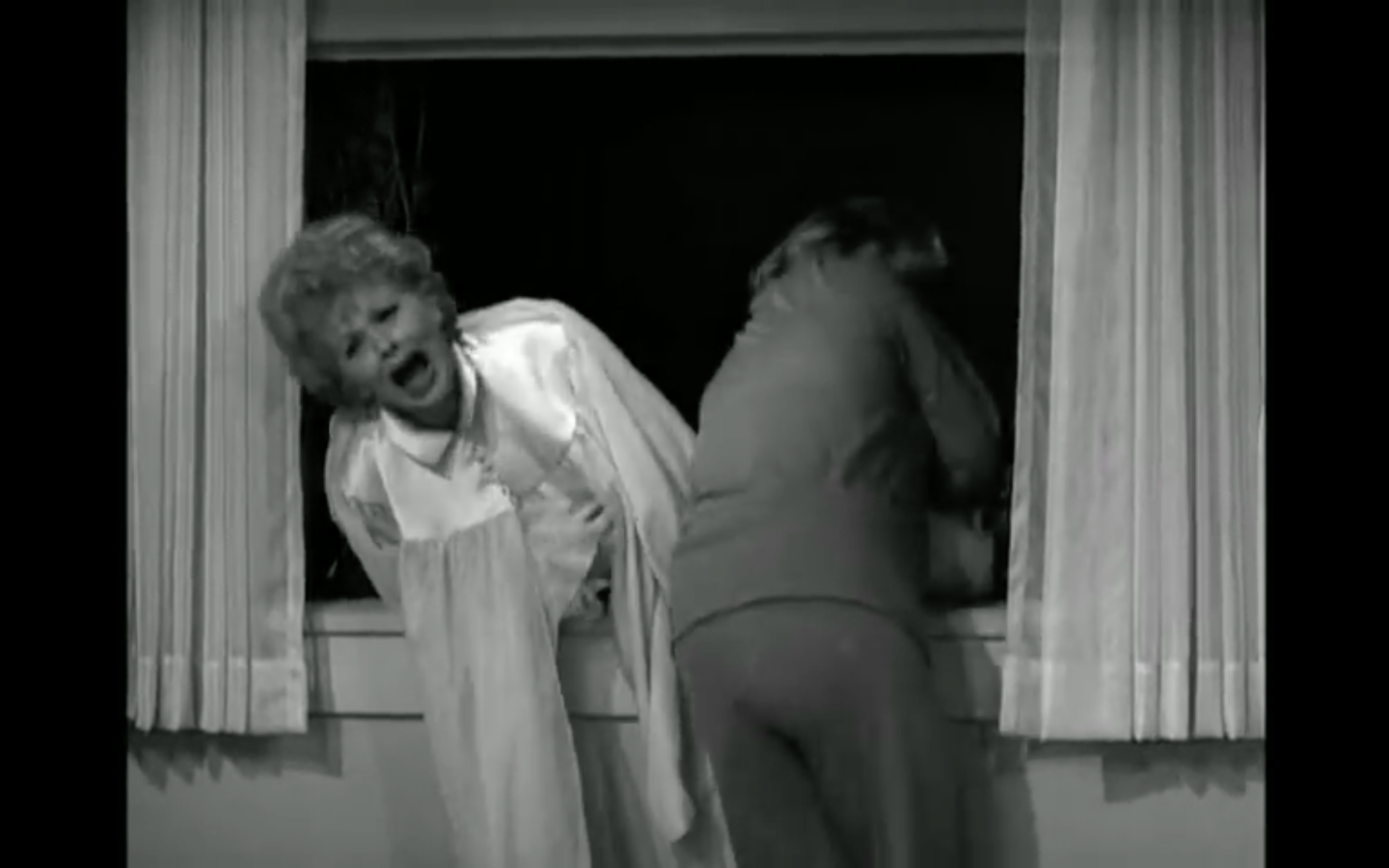
There were several sitcom showdowns during the 1963-64 and 1964-65 seasons. Though ABC introduced some successful new sitcoms (Bewitched, The Addams Family, The Patty Duke Show, The Farmer’s Daughter) during those two seasons, the network also foolishly tried to launch a few new sitcoms against some of CBS’ top hits.
1963-64
The Farmer’s Daughter vs. Harry’s Girls on Friday at 9:30 p.m. (ET)
Based on an old Loretta Young movie, The Farmer’s Daughter, starring Inger Stevens and William Windom, debuted on ABC in the fall of 1963. At the same time, NBC launched Harry’s Girls in the Friday night at 9:30 timeslot. This new sitcom about a vaudeville entertainer and his dancers lacked a promising concept, but it did have a unique element—it was filmed in locations around Europe.
By mid-season, neither show was still in the timeslot. However, they had different fates. Harry’s Girls was cancelled and soon forgotten. The Farmer’s Daughter moved to Wednesday, where it was part of a comedy block that included The Adventures of Ozzie and Harriet and The Patty Duke Show. Though never a big hit, the series would go on to a three-year run.
Winner: The Farmer’s Daughter
The New Phil Silvers Show vs. The Joey Bishop Show on Saturday at 8:30
Phil Silvers was four years removed from his hit CBS military sitcom The Phil Silvers Show. The network hoped lightning would strike twice, with Silvers playing another sneaky character, this time in a civilian setting. The network’s confidence in Silvers showed in the placement of his new show on Saturday night between hits, Jackie Gleason’s American Scene Magazine and The Defenders. The Joey Bishop Show on NBC didn’t have the benefit of being part of a strong lineup, but it was in the third year of a moderately successful run on NBC.
The New Phil Silvers Show was a disappointment. Viewers expressed dissatisfaction with the format, and the show struggled even though its Jackie Gleason lead-in was the season’s 15th highest-ranked show. CBS moved Silvers back an hour at mid-season and made his character more likable by adding a domestic element to the show. It didn’t work, and the series was cancelled at season’s end. Although The Joey Bishop Show was more successful, NBC nevertheless cancelled it. CBS execs thought the show still had some life left in it and picked it up for a one-season run on that network.
Winner: The Joey Bishop Show
1964-65
The Andy Griffith Show vs. No Time for Sergeants vs. Tom, Dick, and Mary on Monday at 8:30
This is the weirdest challenge ABC made to a CBS hit. The Andy Griffith Show was about to begin its 5th season on CBS, after finishing no lower than 7th in its previous four seasons on Monday night. For the fall of 1964, it was moved up an hour to 8:30. ABC chose to put an untested sitcom against Griffith. Strangely, that series, No Time for Sergeants, was based in part on a movie of the same name that starred none other than Andy Griffith and Don Knotts. Of course, neither actor would be part of the new series. NBC also scheduled a new sitcom, Tom, Dick, and Mary, against Griffith. That series was part of a 90-minute block of new sitcoms collectively called 90 Bristol Court, although each show was its own half-hour series.
Predictably, The Andy Griffith Show continued to draw high ratings, finishing 4th for the season. The series never left the top 10 in its eight-year run. Tom, Dick, and Harry finished near the bottom of the Nielsen ratings and was dropped at mid-season. Although No Time for Sergeants performed respectably, finishing in 40th place for the season, ABC cancelled it after just one year.
Winner: The Andy Griffith Show
The Lucy Show vs. Wendy and Me on Monday at 9:00
The Lucy Show aired right after The Andy Griffith Show in the fall of 1964. Like Griffith, it was in a new timeslot, moving back from 8:30 to 9:00. Also like Griffith, it was a top 10 favorite throughout its run. The season almost didn’t happen as Ball originally announced she wasn’t going to do another year of the show after losing her head writers and co-star Vivian Vance expressing a desire to retire from the series. However, new writers were hired, and Vance agreed to return if she could get a few weeks off during the season. ABC scheduled the return of another 1950s sitcom star, George Burns, opposite Lucy. In his new show, Burns would be paired with Connie Stevens in Wendy and Me, a new series that debuted shortly after the death of Gracie Allen, who had retired from the act in 1958.
Lucy continued to prosper, finishing in 8th place in the Nielsens. Burns’ new vehicle only lasted one season against such strong competition.
Winner: The Lucy Show
The Dick Van Dyke Show vs. Mickey on Wednesday at 9:00
Once more, ABC put a new sitcom head-to-head with a CBS hit. The Dick Van Dyke Show was coming off a hugely successful third season, finishing 3rd in the Nielsen Ratings. CBS bumped it up a half hour to 9:00 on Wednesday for the fall of 1964. ABC had a star of its own in Mickey Rooney. The once big movie star was signed to star in Mickey, a new sitcom about a family that inherits a hotel.
Viewers remained loyal to The Dick Van Dyke Show, as it finished 7th in the season’s ratings. The slight dip can be attributed to the fact that its lead-in, The Beverly Hillbillies, which had also moved to an earlier timeslot, dropped from 1st to 12th on the ratings chart. Mickey was a disaster from day one, thanks to bad ratings and reviews. Co-star Sammee Tong, well-known from his stint on Bachelor Father, ended his life in late October, and the series left the air at mid-season. ABC simply expanded its lead-in, Shindig, to an hour. Somehow, Rooney won a Golden Globe for the show. The Dick Van Dyke Show went on to one more successful season before ending at its stars’ request.
Winner: The Dick Van Dyke Show
Broadside vs. The Bill Dana Show on Sunday at 8:30
ABC had a hit with McHale’s Navy, so why not launch a similar sitcom with many of the same people behind the scenes? Broadside was also set during World War II, but involved the goings-on of a group of WAVES. NBC countered with second-season sitcom The Bill Dana Show. Dana’s series replaced Grindl, an Imogene Coca series that was fairly successful but didn’t return due to a budget standoff between the network and the show’s sponsor. Dana starred as Jose Jimenez, a character he had played on The Steve Allen Show and The Danny Thomas Show. The series co-starred Don Adams, was written mostly by Danny Thomas writers, and was nominated for an Emmy for best comedy series. But the ratings were low in a too-early Sunday at 7:00 timeslot. The Grindl cancellation gave the show a second chance.
Although it was sandwiched between hits Walt Disney’s Wonderful World of Color and number one Bonanza, the new timeslot didn’t help The Bill Dana Show’s ratings enough and it was cancelled at mid-season. Its replacement, the western Branded, was an initial success but was cancelled in 1966. Broadside lasted the full season, but it too was cancelled after one year. The competition of Branded and CBS’ The Ed Sullivan Show was too much for the rookie series.
Winner: No one
The Bing Crosby Show vs. Many Happy Returns on Monday at 9:30
ABC had a hit in My Three Sons with movie star Fred McMurray starring in the domestic series. So ABC debuted a new sitcom with movie and singing star Bing Crosby in a domestic series. Unfortunately for Crosby, his series was scheduled on Mondays, behind another new show, Wendy and Me. His CBS competition, Many Happy Returns, a new sitcom set in a department store’s returns section, had the advantage of following perennial top ten series The Lucy Show.
Buried in a bad timeslot, The Bing Crosby Show predictably died after just one season. Although it received higher ratings (50th place), Many Happy Returns also lasted just one year, as its ratings drop from The Lucy Show was too large for the series to return for a second season.
Winner: No one
The Baileys of Balboa vs. Hazel on Thursday at 9:30
CBS executive James Aubrey was not happy with the format of Gilligan’s Island, a new series set to debut on CBS in the fall of 1964. He wanted to show to center on a charter boat heading to different locations, so he ordered The Baileys of Balboa, a new sitcom about a charter boat. The series was one of three new CBS series (also The Reporter and The Cara Williams Show) produced without a pilot. All three shows just happened to come from the production company run by Keefe Brasselle, a close friend of Aubrey’s. The subsequent fallout from those shows’ failure and the questionable deals made to produce the shows helped cost Aubrey his job. Originally, The Baileys was set to air on Tuesday at 9:30, behind the hit The Red Skelton Show. However, when Lucille Ball decided to return to her Monday night series, CBS rescheduled second-year hit Petticoat Junction. Originally slated for Monday, it would return to Tuesday nights in the slot originally intended for The Baileys of Balboa. The Baileys would now face sitcom competition from NBC’s fourth-year hit, Hazel, coming off a season where it finished 22nd in the Nielsen Ratings.
The Baileys of Balboa flopped. One week, it even finished last in the ratings. Struggling badly, it was slated to move to Friday at mid-season but ended up staying in its tough Thursday timeslot. ABC’s nighttime serial Peyton Place, led in by Bewitched, TV’s number two show, hit the top ten in the timeslot. Hazel fell to 42nd place. While both The Baileys and Hazel were cancelled, Hazel was picked up for a fifth and final season by CBS.
Winner: Hazel
Leave a Reply