
The moment Maude Findlay appeared at the Bunkers’ doorstep looking impossibly intimidating and stern in a 1971 episode of All in the Family, a TV star was born. Tony-winning actress Bea Arthur was largely unknown to television audiences at the time. Still, the studio audience at the All in the Family taping roared with laughter every time Arthur opened her mouth to chastise Archie Bunker.
The members of that audience weren’t the only ones impressed by Arthur’s performance. CBS executive Fred Silverman called producer Norman Lear before the episode was over, asking him to create a series for Arthur. The subsequent show, Maude, premiered to huge ratings the following fall, and the audience’s affection for the outspoken character continued as the show hit Nielsen’s top 10 in each of its first four seasons.
Those numbers finally started to dip in the show’s fifth and sixth seasons. Though the series still attracted enough viewers to earn its spot on CBS’ Monday night schedule. However, in January of 1978, the network moved M*A*S*H into Maude’s Monday night slot to help that series escape its Tuesday night competition, Three’s Company, which had been beating it soundly. Maude was sent packing to Saturday night, just as ABC had moved its freshman hit, The Love Boat, into the slot opposite Maude. As a result, Maude sank to near the bottom of the ratings.
What’s more, Maude co-stars Adrienne Barbeau, Conrad Bain, and Rue McClanahan had landed leading roles in pilots and planned to depart Maude. While Barbeau’s The Fighting Nightingales and Bain’s 45 Minutes From Harlem were rejected by CBS and ABC, respectively, McClanahan’s Apple Pie was picked up by ABC. However, it was cancelled after its second episode landed in last place in the ratings. Bain’s pilot was remade at NBC as Diff’rent Strokes, and lasted eight seasons.
With the departure of cast members and low ratings, Maude needed a refresh. In a three-part season ender, a congresswoman friend of Maude’s drops dead in the Findlay’s living room. (The second time a visitor met their demise at the Findlays—an example of the show’s dark humor.) Maude is appointed to replace her, and she and her retiring husband, Walter (Bill Macy), move to Washington, D.C., in the final episode of the trilogy.
The premise for what was intended to be a seventh season involves the idealistic Maude realizing she must compromise and listen to her experienced staff if she is going to accomplish anything. The episode was very funny as Maude initially clashed with her staff (Barbara Rhoades, Dennis Burkley, and Sarina C. Grant) and her pushy maid (the always hilarious Nedra Volz, who previously appeared in several Lear productions). By my count, she’s Maude’s fifth maid, if you include Rita, who was hired to be Florida’s replacement in the second season but never appeared in another episode.
However, Bea Arthur had tired of the grind of a weekly series and thought it was better to end the show rather than start from scratch. Never one to waste a good idea, Norman Lear thought the format could work without Arthur and Macy, if he could find a sufficient replacement. Realizing the lead character could be a woman or a man, he suggested John Amos for the new star, even though he had dropped Amos from Good Times just two years earlier, as he had become too difficult for Lear’s taste.
Under the name Onward and Upward, a pilot was shot with the same supporting cast playing Amos’ staff. Amos’ character was an African American who was a former football player and owned a construction company specializing in housing for low-income individuals, and was new to Congress. CBS liked it and scheduled it as a mid-season replacement, set to air in 1979 between All in the Family and Alice on Sunday night. Producer Charlie Hauck called it “A time slot that any production company would kill for.” It looked like there was a new hit in the making.
Unfortunately, Amos demanded creative control and left the series when he didn’t receive it. The producers sought a new lead, with Louis Gossett Jr. and Peter Boyle reportedly under consideration. The NAACP urged Lear’s T.A.T. Communications to cast a Black star as the replacement. When Cleavon Little became available, he took over as the new lead actor, despite being less believable than Amos as a former athlete and having a different acting style.
While Amos reportedly played the new congressman as forceful and unyielding, Little apparently brought more vulnerability to the role. He also had trouble memorizing his lines, which impacted his performance in front of the live studio audience. His over-the-top acting in the 1971 All in the Family episode “Edith Writes a Song” should have provided a clue that he was possibly miscast.
Three episodes of the new series were shot before its scheduled March premiere. Originally titled Mister Dooley, it was retitled Mister Dugan to avoid confusion with the fictional Mr. Dooley character created by humorist Finley Peter Dunne. Trouble was brewing as the debut date approached. T.A.T. registered complaints from the NAACP and the Congressional Black Caucus before they had even seen the show.
Executives at T.A.T. were also having misgivings about the show. A private showing at Lear’s home for an African-American audience did not go well. However, it was a screening for the Congressional Black Caucus that caused Lear to throw in the towel, refusing to deliver the series to CBS just days before the scheduled debut, after it had been promoted on the air and in TV Guide. The congresspeople objected to what they thought was a negative portrayal of Blacks in politics. One congressperson described Dugan as “A silly, incompetent man ruled by his staff.”
Producer Hauck thought they took the show too seriously, failing to recognize that comedy involves human frailties, especially in Lear’s show. He also acknowledged that Little’s acting style was responsible for some of the controversy. It was not a good season for Hauck, who also produced the short-lived Apple Pie and made a widely ridiculed pilot that involved actors in dog suits.
Cleavon Little was disappointed and thought it was a wasted opportunity. Lear’s company ate more than a million dollars. But Lear had an idea to recoup some of that loss and salvage what he thought was still a viable concept.
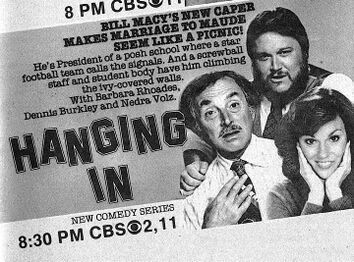
In the summer of 1979, TV Guide announced that Maude’s Bill Macy would star in an upcoming series titled Mister Principal. It provided few details other than that it would be set at a private school. Just a few weeks later, the magazine reported that Macy’s new series would be titled The Big Nine and was, in fact, a reworked version of Mister Dugan, now in an academic setting. In replacing Little with a white actor, I assume the producers thought it would be unseemly to place him in the exact same show.
Rhoades, Burkley, and Volz would all return in similar roles. Sarina C. Grant was no longer in the cast, and Darian Mathias had joined the ensemble. Macy’s Lou Harper character was still a former football player, which didn’t fit Macy. He was also an idealist, having high hopes for what he could do as the new president of the university. However, his aggressive staff brought him back to reality. Sound familiar? It should as some of the episodes used reworked Mister Dugan scripts — all of which were written by former Maude scribes.
More than a year after the final episode of Maude, the series finally premiered on August 8, 1979, under the generic moniker Hanging In. At least they didn’t call it AfterMaude. The academic setting didn’t have the same bite as Washington, D.C. Following another summer comedy, Dorothy, Hanging In premiered near the bottom of the ratings. Like Dorothy (a series eerily similar to The Facts of Life, which premiered a couple of weeks later and lasted nearly nine years), Hanging In ran for just four episodes, making it hardly worth the trouble to get it on the air.
Leave a Reply